 Andiamo Places

Puglia itinerary: 7, 10 or 14 days
Puglia in 7, 10 or 14 days, the way we travelled it: first a base on the coast near Bari (Polignano a Mare) for Matera's cave town, Monopoli's harbour, the trulli of Alberobello, the white towns of the Valle d'Itria and Ostuni; then a base in Otranto for baroque Lecce, the sea caves and beaches of the Salento coast and Gallipoli. The 14-day plan starts further north, with the Gargano's sea caves and Vieste, and Trani's cathedral by the sea with Castel del Monte. Every day comes from our checked city guides.
How long do you have?
Map: 14 days
Puglia in 7 days
Day 1
Monopoli Cathedral
Baroque cathedral of the Madonna della Madia in Monopoli's old town, with a rich marble interior and paintings.

Castle of Charles V (Monopoli)
16th-century seafront castle on the edge of Monopoli's old town, used for exhibitions, with walls rising from the rocks.
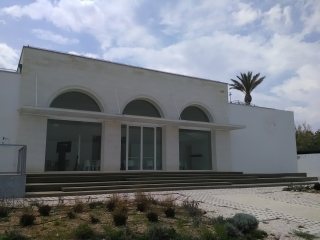
Pino Pascali Museum
Contemporary art museum on the cliff in Polignano, named after the local artist Pino Pascali, with changing exhibitions and a sea view.

Historic centre of Polignano a Mare
A walk through whitewashed lanes to terraces on the cliff edge, the Matrice church and the statue of the singer Domenico Modugno.

Lama Monachile
Small pebble cove between high limestone cliffs at the foot of the old town, used for swimming and sometimes cliff-diving events.

Ponte Borbonico viewpoint
The 19th-century bridge over Lama Monachile, giving the classic view down into the cove and up to the old town on the cliffs.

Statue of Domenico Modugno
A bronze statue of the singer of 'Volare', born in Polignano, standing with arms flung wide towards the sea.
Cala Paura
A tiny fishermen's cove at Polignano with boats pulled up on the rocks, where locals swim from the rocks.

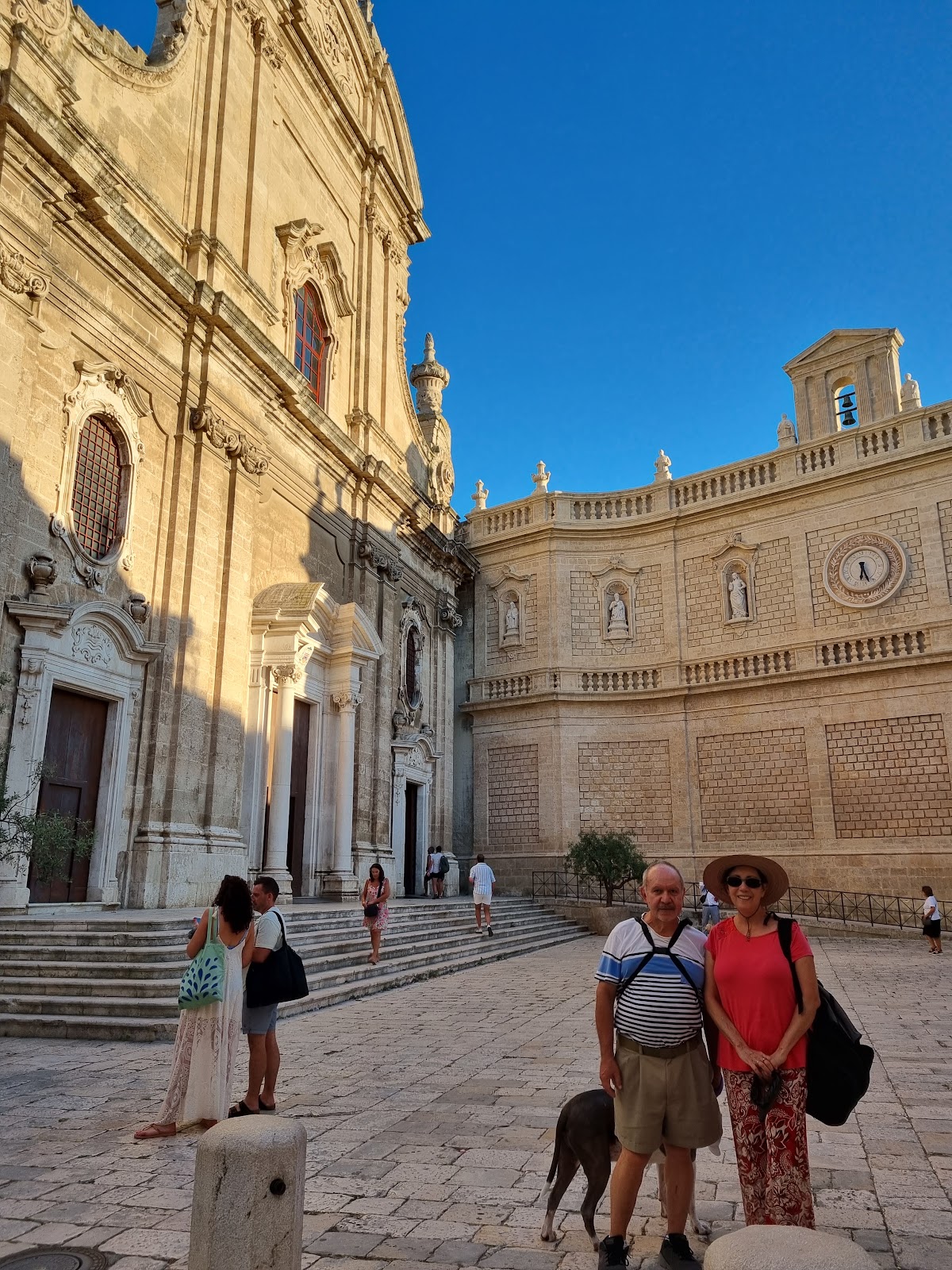
Old town and old port of Monopoli
A walk through Monopoli's white old town, along its sea walls to the old port with its blue fishing boats.
Day 2

Sasso Caveoso
The southern of Matera's two cave districts, with cave houses and rock churches stacked along the edge of the ravine.
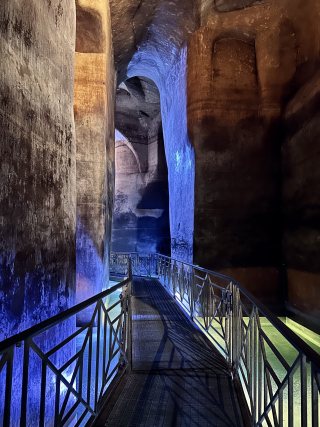
Palombaro Lungo
Huge underground water cistern beneath Piazza Vittorio Veneto, carved into the rock and shown on guided tours.
Sasso Barisano
The northern cave district, with carved facades, rock churches and many cave houses now restored as hotels and restaurants.

San Pietro Barisano
The largest rock church in the Sassi, with an underground crypt where the dead were once drained in niches.

Matera Cathedral
Apulian-Romanesque cathedral of the 13th century on the ridge between the two Sassi, with a rose window and Baroque interior.

San Pietro Caveoso
17th-century church on a square at the edge of the ravine, below the rock of Santa Maria de Idris.

Santa Maria de Idris
Rock church at the top of the Monterrone crag, with medieval frescoes and views over the Sasso Caveoso.

Belvedere Murgia Timone
Viewpoint on the plateau across the ravine, facing the whole of the Sassi, with prehistoric caves and rock churches nearby.
Day 3

Trullo Sovrano
The only two-storey trullo in Alberobello, an 18th-century house with a small museum showing how a family lived inside.

Basilica of Saints Cosmas and Damian
The town's main church, a neoclassical basilica with twin bell towers at the top of the main street.

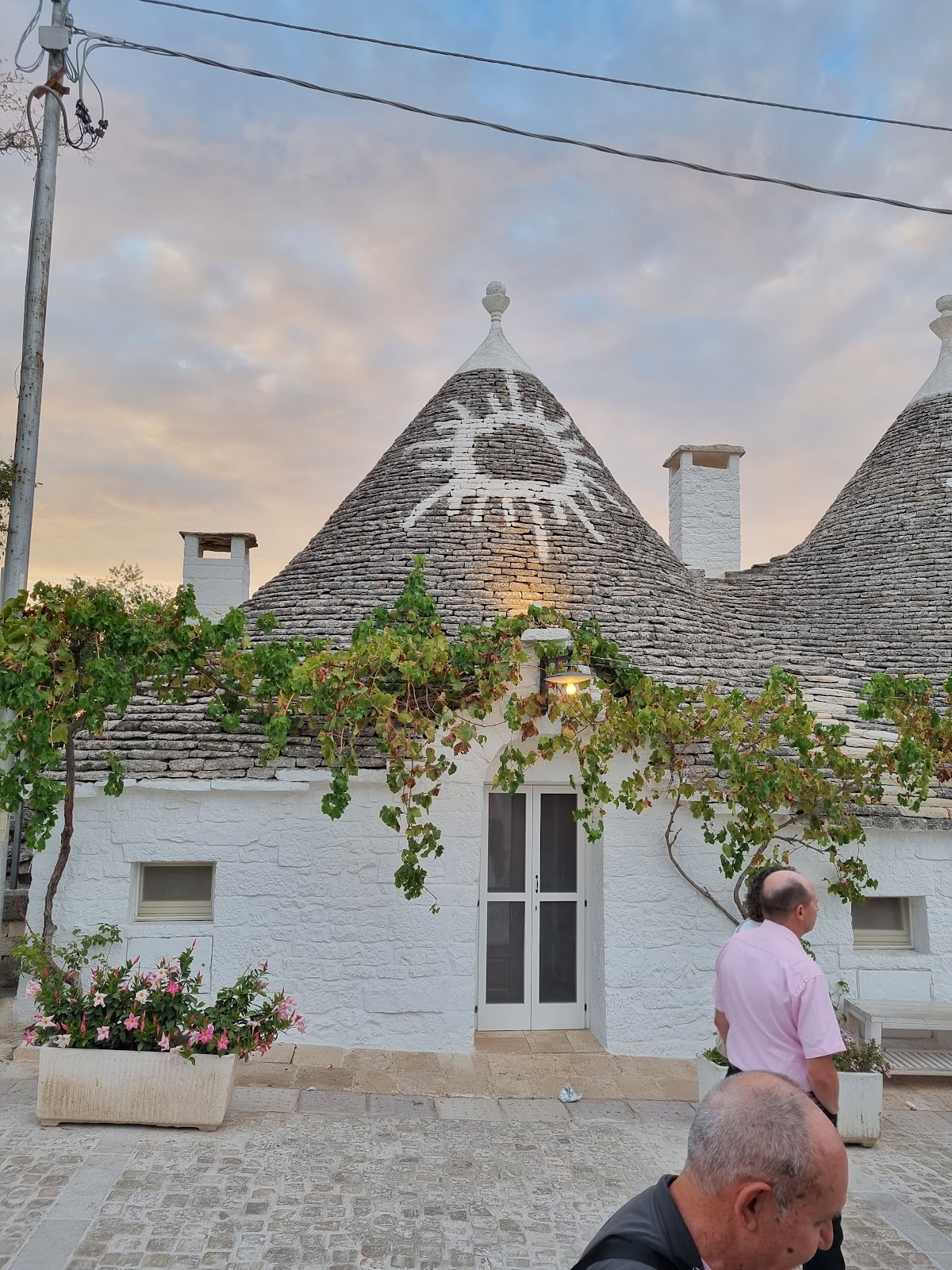
Historic centre of Alberobello (Rione Monti trulli)
A walk through the hillside lanes of Rione Monti, packed with over a thousand whitewashed trulli with conical stone roofs, a UNESCO World Heritage site.

Church of Sant'Antonio (trullo church)
A church in Alberobello built in the shape of a trullo, with a conical stone roof like the houses around it.
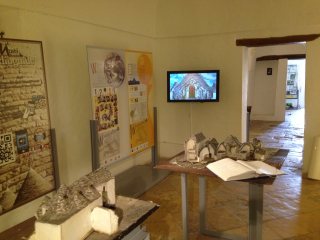
Museo del Territorio (Casa Pezzolla)
Local history museum in a group of linked trulli, explaining how the dry-stone houses were built and lived in.
Rione Aia Piccola
The quieter trulli quarter of Alberobello where people still live; narrow lanes of whitewashed cones with fewer crowds than Rione Monti.
Belvedere Santa Lucia
The classic viewpoint over the conical trulli roofs of Rione Monti, particularly good in late-afternoon light.

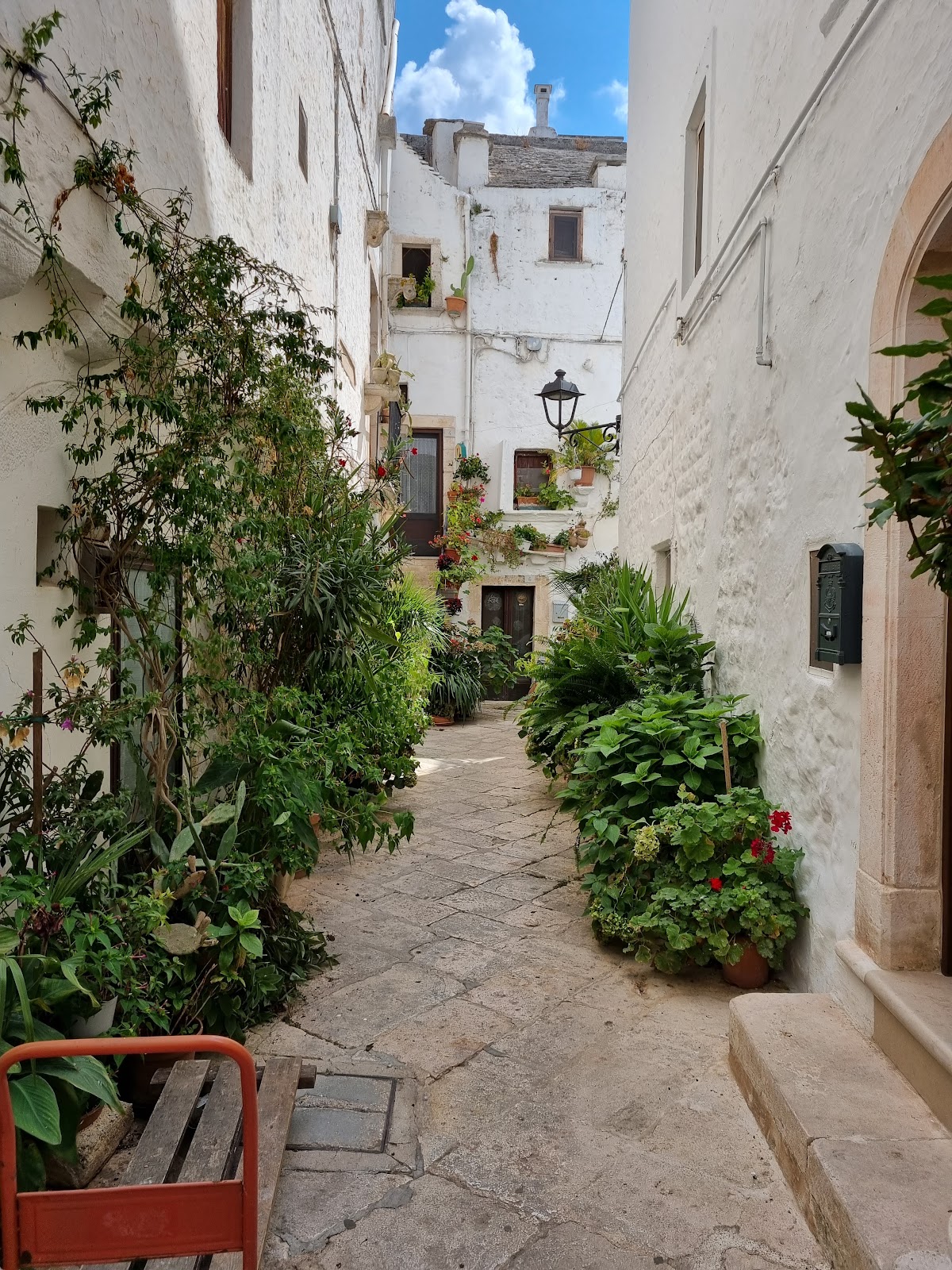
Historic centre of Locorotondo
Round old town of whitewashed lanes, flower-filled balconies and steep-roofed houses on a hill above the valley, one of Italy's most beautiful villages.
Chiesa Madre di San Giorgio (Locorotondo)
Large neoclassical mother church at the top of Locorotondo's old town, with a dome visible across the valley.
Day 4

Ostuni Cathedral
Late Gothic cathedral at the top of the old town, with a large rose window on its pale stone facade.

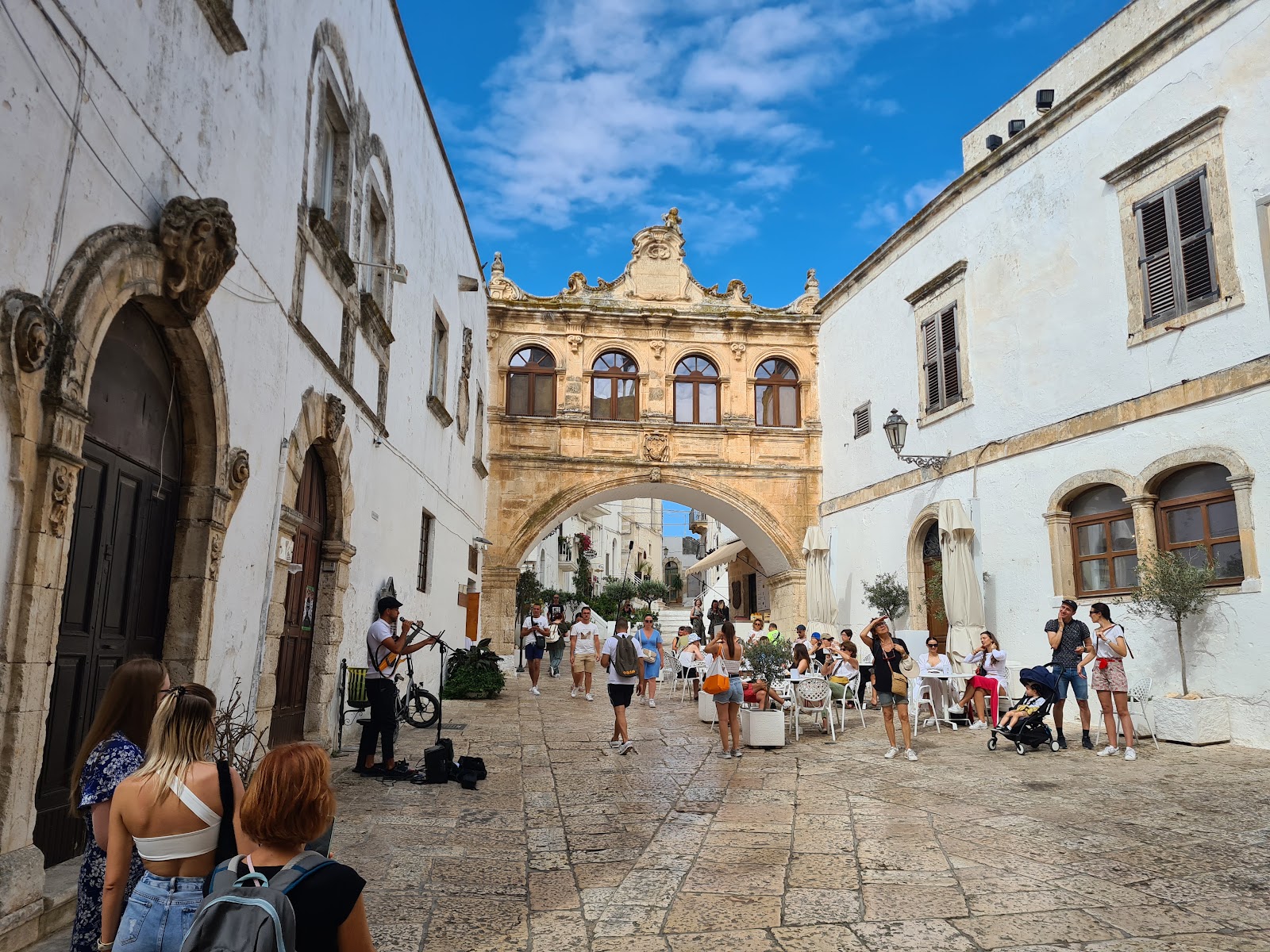
Historic centre of Ostuni
A walk through the whitewashed 'white town', with stepped lanes, arches and small squares climbing the hill to the Cathedral.
Museum of Preclassical Civilizations of the Southern Murgia
Small archaeology museum in a former convent, known for the remains of a prehistoric pregnant woman found in a nearby cave.

Bishop's Palace and Arco Scoppa
The bishop's palace beside the Cathedral, joined to the seminary by the Arco Scoppa, a raised arch over the lane.
Porta Nova
One of the old town's gates in the Aragonese walls, flanked by a round tower, at the start of the climb into the centre.
Belvedere viewpoint
Terrace on the edge of the old town looking over the plain of olive groves to the Adriatic Sea.
Villanova (Ostuni's seaside)
Ostuni's little harbour on the coast, about 15 minutes away by car, with rocky coves and a few seafood restaurants.

Day 5

Museo Faggiano
A private house where works on the plumbing uncovered layers of history, from Messapian tombs to medieval rooms below the floors.
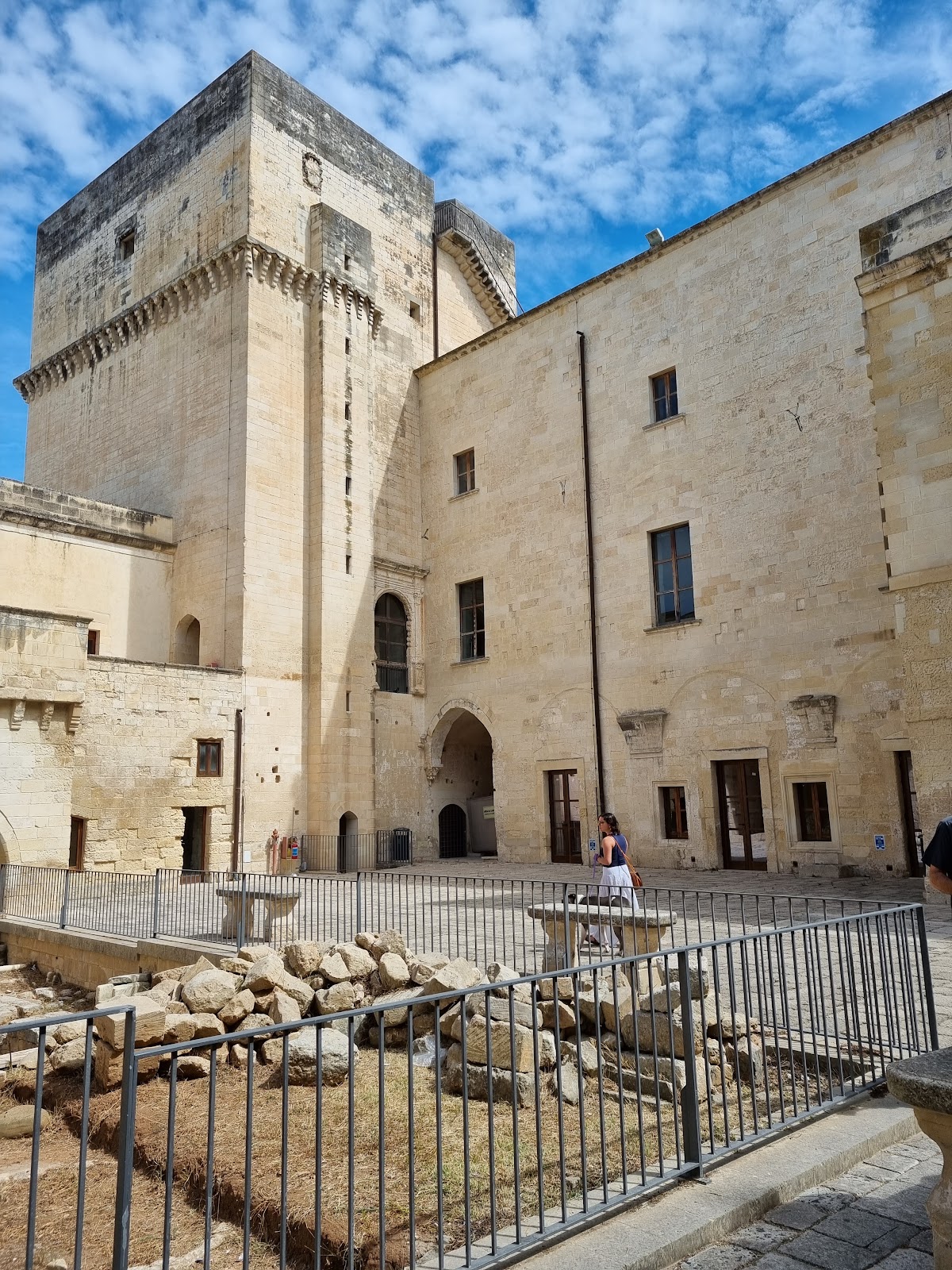
Castle of Charles V
16th-century fortress built for Emperor Charles V around an older castle, with courtyards, halls and exhibitions.

Palazzo dei Celestini
Former Celestine monastery next to Santa Croce, with a long carved Baroque facade, now the seat of the provincial government.
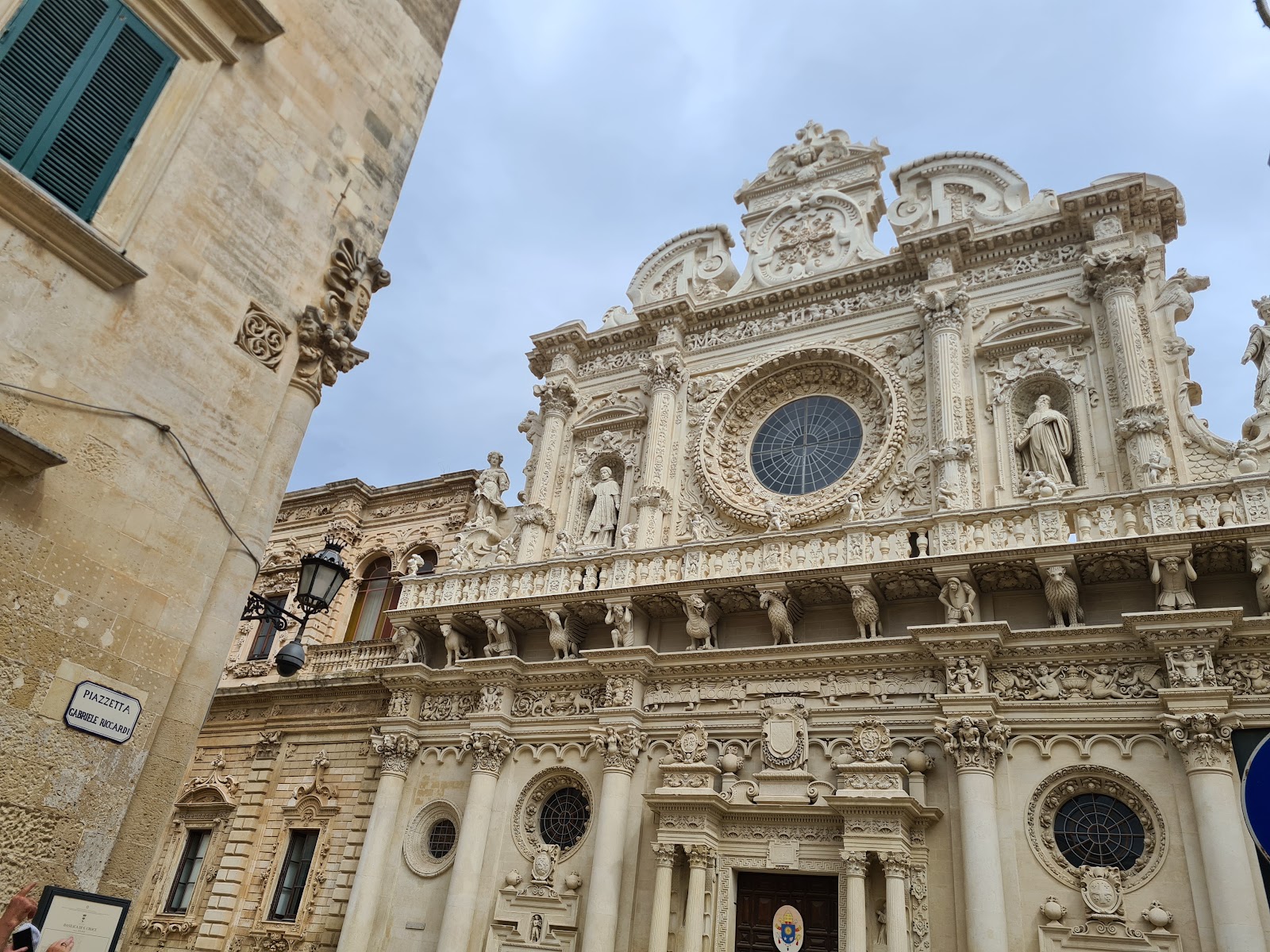
Basilica of Santa Croce
Lecce's showpiece Baroque church, its facade carved in soft local stone with animals, figures and a large rose window.

Roman amphitheatre of Lecce
Partly excavated 2nd-century Roman amphitheatre, sunk below Piazza Sant'Oronzo and seen from the square above.

Piazza Sant'Oronzo
The main square of Lecce, with a column topped by the city's patron saint and part of the Roman amphitheatre below street level.

Church of Santa Chiara
Church by Rosario Gagliardi with an oval interior; its convent terrace gives one of the best views over the Corso.

Roman theatre of Lecce
Small Roman theatre found among the old town houses, with a museum of finds next to it.

Lecce Cathedral and Piazza del Duomo
Enclosed square entered through an archway, with the cathedral, its tall bell tower, the bishop's palace and the seminary.

Museo Sigismondo Castromediano
Provincial museum of archaeology and art, with Messapian and Roman finds, painted vases and a picture gallery.

Church of San Matteo
Baroque church with an unusual facade, convex in its lower part and concave above.

Porta San Biagio
One of the three surviving city gates, rebuilt in 1774, opening onto Piazza d'Italia at the southern edge of the old town.
Day 6

Roca Vecchia archaeological area
Bronze Age and Messapian ruins on a rocky promontory above the sea, right beside the Grotta della Poesia.

Grotta della Poesia
A natural sinkhole pool open to the sea at Roca, famous for its clear water; swim or jump in, best early before the crowds.
Torre dell'Orso beach and the Due Sorelle
A long white-sand beach in a pine-backed bay, watched over by the Due Sorelle, two rock stacks just offshore.

Torre Sant'Andrea sea stacks
Limestone sea stacks, arches and small coves along the shore at Torre Sant'Andrea, at their best in the early morning or late light.

Baia dei Turchi
A wild, sandy bay backed by pine woods north of Otranto, reached on foot from the coast road, with clear turquoise water and no facilities.

Day 7

Otranto Cathedral
Norman cathedral famous for its 12th-century floor mosaic of the Tree of Life and a chapel with the relics of the Martyrs of Otranto.
Church of San Pietro
Small Byzantine church in the old town, with domes and old frescoes inside, one of the oldest buildings in Otranto.

Historic centre of Otranto
A walk through white lanes inside the walls, along the ramparts above the harbour and down to the seafront promenade.

Aragonese Castle of Otranto
15th-century castle with round towers and a moat, which gave its name to Walpole's Gothic novel, used for exhibitions.

Cava di Bauxite lake
Abandoned bauxite quarry just outside Otranto, where a green lake lies among red earth and rocks.

Punta Palascìa lighthouse (Capo d'Otranto)
The lighthouse at Italy's easternmost point, where the Adriatic meets the Ionian, reached by a short walk and giving sea views.
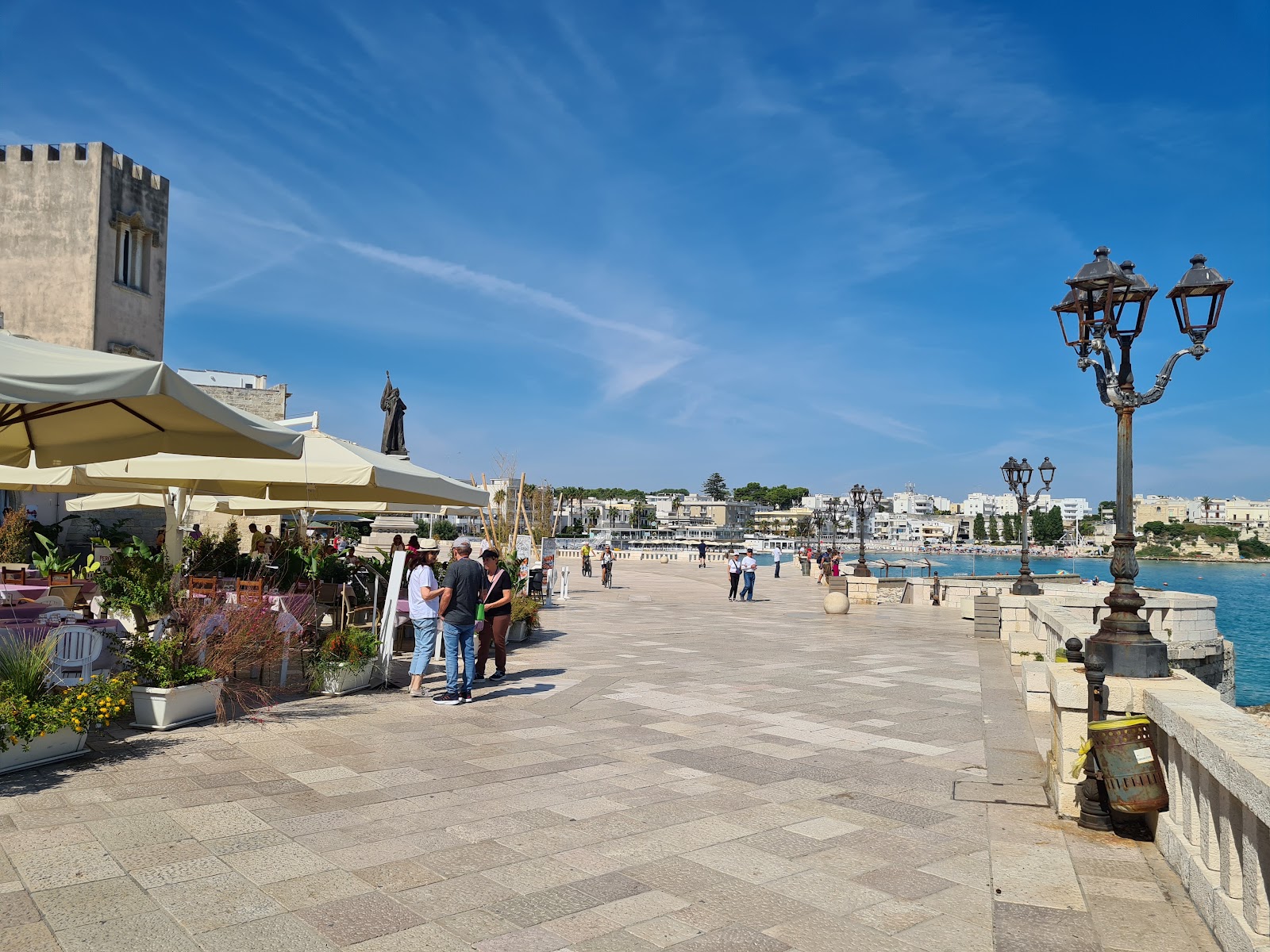
Lungomare degli Eroi
Otranto's seafront promenade beneath the old walls, busy at sunset and after dinner.
Open this 7-day plan, freeChange this trip in the Trip BuilderChange it in the app
Puglia in 10 days
Day 1
Monopoli Cathedral
Baroque cathedral of the Madonna della Madia in Monopoli's old town, with a rich marble interior and paintings.
Castle of Charles V (Monopoli)
16th-century seafront castle on the edge of Monopoli's old town, used for exhibitions, with walls rising from the rocks.
Pino Pascali Museum
Contemporary art museum on the cliff in Polignano, named after the local artist Pino Pascali, with changing exhibitions and a sea view.
Historic centre of Polignano a Mare
A walk through whitewashed lanes to terraces on the cliff edge, the Matrice church and the statue of the singer Domenico Modugno.
Lama Monachile
Small pebble cove between high limestone cliffs at the foot of the old town, used for swimming and sometimes cliff-diving events.
Ponte Borbonico viewpoint
The 19th-century bridge over Lama Monachile, giving the classic view down into the cove and up to the old town on the cliffs.
Statue of Domenico Modugno
A bronze statue of the singer of 'Volare', born in Polignano, standing with arms flung wide towards the sea.
Cala Paura
A tiny fishermen's cove at Polignano with boats pulled up on the rocks, where locals swim from the rocks.
Old town and old port of Monopoli
A walk through Monopoli's white old town, along its sea walls to the old port with its blue fishing boats.
Day 2
Sasso Caveoso
The southern of Matera's two cave districts, with cave houses and rock churches stacked along the edge of the ravine.
Palombaro Lungo
Huge underground water cistern beneath Piazza Vittorio Veneto, carved into the rock and shown on guided tours.
Sasso Barisano
The northern cave district, with carved facades, rock churches and many cave houses now restored as hotels and restaurants.
San Pietro Barisano
The largest rock church in the Sassi, with an underground crypt where the dead were once drained in niches.
Matera Cathedral
Apulian-Romanesque cathedral of the 13th century on the ridge between the two Sassi, with a rose window and Baroque interior.
San Pietro Caveoso
17th-century church on a square at the edge of the ravine, below the rock of Santa Maria de Idris.
Santa Maria de Idris
Rock church at the top of the Monterrone crag, with medieval frescoes and views over the Sasso Caveoso.
Belvedere Murgia Timone
Viewpoint on the plateau across the ravine, facing the whole of the Sassi, with prehistoric caves and rock churches nearby.
Day 3

Trani Cathedral
Apulian Romanesque cathedral of pale stone standing alone by the sea, dedicated to Saint Nicholas the Pilgrim, with crypts and a tall bell tower.

Scolanova Synagogue
Thirteenth-century synagogue in Trani's old Jewish quarter, later a church and returned to Jewish worship in 2006, a short walk from the cathedral.

Swabian Castle of Trani
Seafront castle begun by Frederick II in the 1230s, beside the cathedral, with restored halls and exhibitions inside.

Historic centre of Trani (the harbour)
Old town around the fishing harbour, with stone palaces, the medieval Jewish quarter and seafood restaurants along the quays.

Castel del Monte
Frederick II's thirteenth-century octagonal castle with eight octagonal towers on a hill in the Murge, a UNESCO World Heritage site.
Day 4

Cala Porta Vecchia
Small sandy cove right under the old town walls, with clear water and a lively summer scene of swimmers and sunbathers.

Monopoli Cathedral (Maria Santissima della Madia)
Rich Baroque cathedral holding the icon of the Madonna della Madia, which legend says arrived by sea on a raft of beams.

Church of Santa Maria Amalfitana
Romanesque church built by merchants from Amalfi, over an older cave chapel, a quiet stone interior in the old town.
Historic centre of Monopoli (Piazza Garibaldi)
The old town's main square, ringed by cafés and old palaces, with white lanes and small churches all around it.
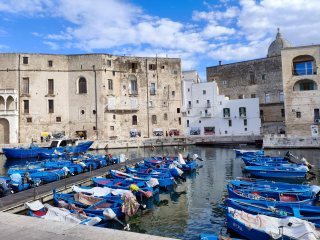
Old harbour (Porto Antico)
Little harbour of blue wooden fishing boats inside the old town, where fishermen still mend nets on the quay.

Sea walls and Bastione Santa Maria
Walk along the old sea walls and the Santa Maria bastion, with the open Adriatic on one side and the white town on the other.
Castle of Charles V
16th-century fortress built for Emperor Charles V around an older castle, with courtyards, halls and exhibitions.
Day 5
Historic centre of Locorotondo
Round old town of whitewashed lanes, flower-filled balconies and steep-roofed houses on a hill above the valley, one of Italy's most beautiful villages.

Mother Church of San Giorgio, Locorotondo
Large neoclassical church crowning the old town, with a dome seen from across the valley and a bright interior.

Locorotondo belvedere over the trulli (Via Nardelli)
Panoramic walk along the edge of the old town, looking over vineyards and scattered trulli across the Valle d'Itria.

Basilica of San Martino, Martina Franca
Eighteenth-century church with a richly carved Baroque facade showing Saint Martin sharing his cloak, the heart of the old town.

Historic centre of Martina Franca (Piazza Maria Immacolata)
Elegant Baroque old town of white lanes and balconied palaces, round the curved arcades of Piazza Maria Immacolata.

Palazzo Ducale, Martina Franca
Seventeenth-century palace of the dukes, now the town hall, with frescoed rooms open to visitors.

Historic centre of Cisternino
Whitewashed hill town above the valley, a maze of lanes, arches and courtyards, where butchers grill meat to order in the evening.
Day 6
Trullo Sovrano
The only two-storey trullo in Alberobello, an 18th-century house with a small museum showing how a family lived inside.
Basilica of Saints Cosmas and Damian
The town's main church, a neoclassical basilica with twin bell towers at the top of the main street.
Historic centre of Alberobello (Rione Monti trulli)
A walk through the hillside lanes of Rione Monti, packed with over a thousand whitewashed trulli with conical stone roofs, a UNESCO World Heritage site.
Church of Sant'Antonio (trullo church)
A church in Alberobello built in the shape of a trullo, with a conical stone roof like the houses around it.
Museo del Territorio (Casa Pezzolla)
Local history museum in a group of linked trulli, explaining how the dry-stone houses were built and lived in.
Rione Aia Piccola
The quieter trulli quarter of Alberobello where people still live; narrow lanes of whitewashed cones with fewer crowds than Rione Monti.
Belvedere Santa Lucia
The classic viewpoint over the conical trulli roofs of Rione Monti, particularly good in late-afternoon light.
Historic centre of Locorotondo
Round old town of whitewashed lanes, flower-filled balconies and steep-roofed houses on a hill above the valley, one of Italy's most beautiful villages.
Chiesa Madre di San Giorgio (Locorotondo)
Large neoclassical mother church at the top of Locorotondo's old town, with a dome visible across the valley.
Day 7
Ostuni Cathedral
Late Gothic cathedral at the top of the old town, with a large rose window on its pale stone facade.
Historic centre of Ostuni
A walk through the whitewashed 'white town', with stepped lanes, arches and small squares climbing the hill to the Cathedral.
Museum of Preclassical Civilizations of the Southern Murgia
Small archaeology museum in a former convent, known for the remains of a prehistoric pregnant woman found in a nearby cave.
Bishop's Palace and Arco Scoppa
The bishop's palace beside the Cathedral, joined to the seminary by the Arco Scoppa, a raised arch over the lane.
Porta Nova
One of the old town's gates in the Aragonese walls, flanked by a round tower, at the start of the climb into the centre.
Belvedere viewpoint
Terrace on the edge of the old town looking over the plain of olive groves to the Adriatic Sea.
Villanova (Ostuni's seaside)
Ostuni's little harbour on the coast, about 15 minutes away by car, with rocky coves and a few seafood restaurants.
Day 8
Museo Faggiano
A private house where works on the plumbing uncovered layers of history, from Messapian tombs to medieval rooms below the floors.
Castle of Charles V
16th-century fortress built for Emperor Charles V around an older castle, with courtyards, halls and exhibitions.
Palazzo dei Celestini
Former Celestine monastery next to Santa Croce, with a long carved Baroque facade, now the seat of the provincial government.
Basilica of Santa Croce
Lecce's showpiece Baroque church, its facade carved in soft local stone with animals, figures and a large rose window.
Roman amphitheatre of Lecce
Partly excavated 2nd-century Roman amphitheatre, sunk below Piazza Sant'Oronzo and seen from the square above.
Piazza Sant'Oronzo
The main square of Lecce, with a column topped by the city's patron saint and part of the Roman amphitheatre below street level.
Church of Santa Chiara
Church by Rosario Gagliardi with an oval interior; its convent terrace gives one of the best views over the Corso.
Roman theatre of Lecce
Small Roman theatre found among the old town houses, with a museum of finds next to it.
Lecce Cathedral and Piazza del Duomo
Enclosed square entered through an archway, with the cathedral, its tall bell tower, the bishop's palace and the seminary.
Museo Sigismondo Castromediano
Provincial museum of archaeology and art, with Messapian and Roman finds, painted vases and a picture gallery.
Church of San Matteo
Baroque church with an unusual facade, convex in its lower part and concave above.
Porta San Biagio
One of the three surviving city gates, rebuilt in 1774, opening onto Piazza d'Italia at the southern edge of the old town.
Day 9
Roca Vecchia archaeological area
Bronze Age and Messapian ruins on a rocky promontory above the sea, right beside the Grotta della Poesia.
Grotta della Poesia
A natural sinkhole pool open to the sea at Roca, famous for its clear water; swim or jump in, best early before the crowds.
Torre dell'Orso beach and the Due Sorelle
A long white-sand beach in a pine-backed bay, watched over by the Due Sorelle, two rock stacks just offshore.
Torre Sant'Andrea sea stacks
Limestone sea stacks, arches and small coves along the shore at Torre Sant'Andrea, at their best in the early morning or late light.
Baia dei Turchi
A wild, sandy bay backed by pine woods north of Otranto, reached on foot from the coast road, with clear turquoise water and no facilities.
Day 10
Otranto Cathedral
Norman cathedral famous for its 12th-century floor mosaic of the Tree of Life and a chapel with the relics of the Martyrs of Otranto.
Church of San Pietro
Small Byzantine church in the old town, with domes and old frescoes inside, one of the oldest buildings in Otranto.
Historic centre of Otranto
A walk through white lanes inside the walls, along the ramparts above the harbour and down to the seafront promenade.
Aragonese Castle of Otranto
15th-century castle with round towers and a moat, which gave its name to Walpole's Gothic novel, used for exhibitions.
Cava di Bauxite lake
Abandoned bauxite quarry just outside Otranto, where a green lake lies among red earth and rocks.
Punta Palascìa lighthouse (Capo d'Otranto)
The lighthouse at Italy's easternmost point, where the Adriatic meets the Ionian, reached by a short walk and giving sea views.
Lungomare degli Eroi
Otranto's seafront promenade beneath the old walls, busy at sunset and after dinner.
Open this 10-day plan, freeChange this trip in the Trip Builder
Puglia in 14 days
Day 1

Sanctuary of Saint Pio of Pietrelcina, San Giovanni Rotondo
Large modern church by Renzo Piano at San Giovanni Rotondo, a major pilgrimage place where the body of Padre Pio is displayed.

Castle of Monte Sant'Angelo
Castle of Norman, Swabian and Aragonese times on the highest point of Monte Sant'Angelo, with views over the gulf of Manfredonia.

Sanctuary of Monte Sant'Angelo
Cave shrine of Saint Michael the Archangel, a pilgrimage place for over a thousand years and a UNESCO World Heritage site.

Foresta Umbra
Ancient beech forest in the heart of the Gargano National Park, part of a UNESCO site, with shady marked walks.

Pizzomunno
Tall white limestone monolith standing on Vieste's Castello beach, tied to a local legend of a fisherman and his lost love.

Trabucco di Punta San Francesco
Old wooden fishing machine of poles and nets on the rocky point by the church of San Francesco, a fine spot at sunset.
Day 2

Boat trip to the Gargano sea caves (from Vieste harbour)
Boat along the limestone coast south of Vieste into sea caves and past rock arches and white cliffs, with stops for a swim in summer.

Historic centre of Peschici (Piazza del Popolo)
White-walled town on a cliff above a sandy bay, with steep lanes, small squares and views from the old walls over the sea.

Vieste old town and Co-cathedral
Old town of whitewashed lanes and steps on a rocky point, crowned by the Romanesque co-cathedral and the castle.
Day 3
Trani Cathedral
Apulian Romanesque cathedral of pale stone standing alone by the sea, dedicated to Saint Nicholas the Pilgrim, with crypts and a tall bell tower.
Scolanova Synagogue
Thirteenth-century synagogue in Trani's old Jewish quarter, later a church and returned to Jewish worship in 2006, a short walk from the cathedral.
Swabian Castle of Trani
Seafront castle begun by Frederick II in the 1230s, beside the cathedral, with restored halls and exhibitions inside.
Historic centre of Trani (the harbour)
Old town around the fishing harbour, with stone palaces, the medieval Jewish quarter and seafood restaurants along the quays.
Castel del Monte
Frederick II's thirteenth-century octagonal castle with eight octagonal towers on a hill in the Murge, a UNESCO World Heritage site.
Day 4

Strada Arco Basso
Old town lane between the castle and the cathedral where local women make orecchiette pasta by hand at their doorsteps.

Castello Normanno-Svevo
Norman castle rebuilt by Emperor Frederick II on the edge of the old town, with a moat, courtyard and exhibitions.

Bari Cathedral
Romanesque cathedral of St Sabinus with a plain white stone facade, a large rose window and a crypt with remains of earlier churches.

Basilica of Saint Nicholas
Romanesque basilica holding the relics of St Nicholas in its crypt, a pilgrimage church for both Catholic and Orthodox Christians.

Piazza Mercantile
Main square of the old town, lined with cafes and the old seat of the city's merchants, with the medieval column of justice.

Piazza del Ferrarese
A lively square in Bari at aperitivo time, with a stretch of exposed Roman road and the old fish market nearby.

Muraglia and Fortino di Sant'Antonio
The old sea wall on the edge of Bari Vecchia, a walkway above the harbour, ending at a small fort.

Teatro Petruzzelli
Bari's grand opera house in the Murat district, rebuilt after a fire in 1991, with performances and guided tours.

Via Sparano (Murat quarter)
The main shopping street of Bari's grid-planned 19th-century town, running from the station area to the old city.

Lungomare Nazario Sauro
Long seafront promenade south of the old town, lined with grand 1930s buildings and street lamps, good for an evening walk.
Day 5
Monopoli Cathedral
Baroque cathedral of the Madonna della Madia in Monopoli's old town, with a rich marble interior and paintings.
Castle of Charles V (Monopoli)
16th-century seafront castle on the edge of Monopoli's old town, used for exhibitions, with walls rising from the rocks.
Pino Pascali Museum
Contemporary art museum on the cliff in Polignano, named after the local artist Pino Pascali, with changing exhibitions and a sea view.
Historic centre of Polignano a Mare
A walk through whitewashed lanes to terraces on the cliff edge, the Matrice church and the statue of the singer Domenico Modugno.
Lama Monachile
Small pebble cove between high limestone cliffs at the foot of the old town, used for swimming and sometimes cliff-diving events.
Ponte Borbonico viewpoint
The 19th-century bridge over Lama Monachile, giving the classic view down into the cove and up to the old town on the cliffs.
Statue of Domenico Modugno
A bronze statue of the singer of 'Volare', born in Polignano, standing with arms flung wide towards the sea.
Cala Paura
A tiny fishermen's cove at Polignano with boats pulled up on the rocks, where locals swim from the rocks.
Old town and old port of Monopoli
A walk through Monopoli's white old town, along its sea walls to the old port with its blue fishing boats.
Day 6
Sasso Caveoso
The southern of Matera's two cave districts, with cave houses and rock churches stacked along the edge of the ravine.
Palombaro Lungo
Huge underground water cistern beneath Piazza Vittorio Veneto, carved into the rock and shown on guided tours.
Sasso Barisano
The northern cave district, with carved facades, rock churches and many cave houses now restored as hotels and restaurants.
San Pietro Barisano
The largest rock church in the Sassi, with an underground crypt where the dead were once drained in niches.
Matera Cathedral
Apulian-Romanesque cathedral of the 13th century on the ridge between the two Sassi, with a rose window and Baroque interior.
San Pietro Caveoso
17th-century church on a square at the edge of the ravine, below the rock of Santa Maria de Idris.
Santa Maria de Idris
Rock church at the top of the Monterrone crag, with medieval frescoes and views over the Sasso Caveoso.

Casa Grotta di Vico Solitario
A furnished cave house showing how families and their animals lived in the Sassi before the 1950s evacuation.
Belvedere Murgia Timone
Viewpoint on the plateau across the ravine, facing the whole of the Sassi, with prehistoric caves and rock churches nearby.
Day 7
Cala Porta Vecchia
Small sandy cove right under the old town walls, with clear water and a lively summer scene of swimmers and sunbathers.
Monopoli Cathedral (Maria Santissima della Madia)
Rich Baroque cathedral holding the icon of the Madonna della Madia, which legend says arrived by sea on a raft of beams.
Church of Santa Maria Amalfitana
Romanesque church built by merchants from Amalfi, over an older cave chapel, a quiet stone interior in the old town.
Historic centre of Monopoli (Piazza Garibaldi)
The old town's main square, ringed by cafés and old palaces, with white lanes and small churches all around it.
Old harbour (Porto Antico)
Little harbour of blue wooden fishing boats inside the old town, where fishermen still mend nets on the quay.
Sea walls and Bastione Santa Maria
Walk along the old sea walls and the Santa Maria bastion, with the open Adriatic on one side and the white town on the other.
Castle of Charles V
16th-century fortress built for Emperor Charles V around an older castle, with courtyards, halls and exhibitions.
Day 8
Historic centre of Locorotondo
Round old town of whitewashed lanes, flower-filled balconies and steep-roofed houses on a hill above the valley, one of Italy's most beautiful villages.
Mother Church of San Giorgio, Locorotondo
Large neoclassical church crowning the old town, with a dome seen from across the valley and a bright interior.
Locorotondo belvedere over the trulli (Via Nardelli)
Panoramic walk along the edge of the old town, looking over vineyards and scattered trulli across the Valle d'Itria.
Basilica of San Martino, Martina Franca
Eighteenth-century church with a richly carved Baroque facade showing Saint Martin sharing his cloak, the heart of the old town.
Historic centre of Martina Franca (Piazza Maria Immacolata)
Elegant Baroque old town of white lanes and balconied palaces, round the curved arcades of Piazza Maria Immacolata.
Palazzo Ducale, Martina Franca
Seventeenth-century palace of the dukes, now the town hall, with frescoed rooms open to visitors.
Historic centre of Cisternino
Whitewashed hill town above the valley, a maze of lanes, arches and courtyards, where butchers grill meat to order in the evening.
Day 9
Trullo Sovrano
The only two-storey trullo in Alberobello, an 18th-century house with a small museum showing how a family lived inside.
Basilica of Saints Cosmas and Damian
The town's main church, a neoclassical basilica with twin bell towers at the top of the main street.
Historic centre of Alberobello (Rione Monti trulli)
A walk through the hillside lanes of Rione Monti, packed with over a thousand whitewashed trulli with conical stone roofs, a UNESCO World Heritage site.
Church of Sant'Antonio (trullo church)
A church in Alberobello built in the shape of a trullo, with a conical stone roof like the houses around it.
Museo del Territorio (Casa Pezzolla)
Local history museum in a group of linked trulli, explaining how the dry-stone houses were built and lived in.
Rione Aia Piccola
The quieter trulli quarter of Alberobello where people still live; narrow lanes of whitewashed cones with fewer crowds than Rione Monti.
Belvedere Santa Lucia
The classic viewpoint over the conical trulli roofs of Rione Monti, particularly good in late-afternoon light.
Historic centre of Locorotondo
Round old town of whitewashed lanes, flower-filled balconies and steep-roofed houses on a hill above the valley, one of Italy's most beautiful villages.
Chiesa Madre di San Giorgio (Locorotondo)
Large neoclassical mother church at the top of Locorotondo's old town, with a dome visible across the valley.
Day 10
Ostuni Cathedral
Late Gothic cathedral at the top of the old town, with a large rose window on its pale stone facade.
Historic centre of Ostuni
A walk through the whitewashed 'white town', with stepped lanes, arches and small squares climbing the hill to the Cathedral.
Museum of Preclassical Civilizations of the Southern Murgia
Small archaeology museum in a former convent, known for the remains of a prehistoric pregnant woman found in a nearby cave.
Bishop's Palace and Arco Scoppa
The bishop's palace beside the Cathedral, joined to the seminary by the Arco Scoppa, a raised arch over the lane.
Porta Nova
One of the old town's gates in the Aragonese walls, flanked by a round tower, at the start of the climb into the centre.
Belvedere viewpoint
Terrace on the edge of the old town looking over the plain of olive groves to the Adriatic Sea.
Villanova (Ostuni's seaside)
Ostuni's little harbour on the coast, about 15 minutes away by car, with rocky coves and a few seafood restaurants.
Day 11
Museo Faggiano
A private house where works on the plumbing uncovered layers of history, from Messapian tombs to medieval rooms below the floors.
Castle of Charles V
16th-century fortress built for Emperor Charles V around an older castle, with courtyards, halls and exhibitions.
Palazzo dei Celestini
Former Celestine monastery next to Santa Croce, with a long carved Baroque facade, now the seat of the provincial government.
Basilica of Santa Croce
Lecce's showpiece Baroque church, its facade carved in soft local stone with animals, figures and a large rose window.
Roman amphitheatre of Lecce
Partly excavated 2nd-century Roman amphitheatre, sunk below Piazza Sant'Oronzo and seen from the square above.
Piazza Sant'Oronzo
The main square of Lecce, with a column topped by the city's patron saint and part of the Roman amphitheatre below street level.
Church of Santa Chiara
Church by Rosario Gagliardi with an oval interior; its convent terrace gives one of the best views over the Corso.
Roman theatre of Lecce
Small Roman theatre found among the old town houses, with a museum of finds next to it.
Lecce Cathedral and Piazza del Duomo
Enclosed square entered through an archway, with the cathedral, its tall bell tower, the bishop's palace and the seminary.
Museo Sigismondo Castromediano
Provincial museum of archaeology and art, with Messapian and Roman finds, painted vases and a picture gallery.
Church of San Matteo
Baroque church with an unusual facade, convex in its lower part and concave above.
Porta San Biagio
One of the three surviving city gates, rebuilt in 1774, opening onto Piazza d'Italia at the southern edge of the old town.
Day 12
Roca Vecchia archaeological area
Bronze Age and Messapian ruins on a rocky promontory above the sea, right beside the Grotta della Poesia.
Grotta della Poesia
A natural sinkhole pool open to the sea at Roca, famous for its clear water; swim or jump in, best early before the crowds.
Torre dell'Orso beach and the Due Sorelle
A long white-sand beach in a pine-backed bay, watched over by the Due Sorelle, two rock stacks just offshore.
Torre Sant'Andrea sea stacks
Limestone sea stacks, arches and small coves along the shore at Torre Sant'Andrea, at their best in the early morning or late light.
Baia dei Turchi
A wild, sandy bay backed by pine woods north of Otranto, reached on foot from the coast road, with clear turquoise water and no facilities.
Day 13
Otranto Cathedral
Norman cathedral famous for its 12th-century floor mosaic of the Tree of Life and a chapel with the relics of the Martyrs of Otranto.
Church of San Pietro
Small Byzantine church in the old town, with domes and old frescoes inside, one of the oldest buildings in Otranto.
Historic centre of Otranto
A walk through white lanes inside the walls, along the ramparts above the harbour and down to the seafront promenade.
Aragonese Castle of Otranto
15th-century castle with round towers and a moat, which gave its name to Walpole's Gothic novel, used for exhibitions.
Cava di Bauxite lake
Abandoned bauxite quarry just outside Otranto, where a green lake lies among red earth and rocks.
Punta Palascìa lighthouse (Capo d'Otranto)
The lighthouse at Italy's easternmost point, where the Adriatic meets the Ionian, reached by a short walk and giving sea views.
Lungomare degli Eroi
Otranto's seafront promenade beneath the old walls, busy at sunset and after dinner.
Day 14

Greek Fountain (Fontana Greca)
Fountain by the bridge decorated with reliefs of myths, long said to be ancient and rebuilt in the 16th century.

Angevin-Aragonese Castle
Sea castle guarding the bridge to the old town, with massive round towers, now open for visits and exhibitions.

Gallipoli Cathedral (Sant'Agata)
Baroque cathedral with a carved stone facade and an interior lined with large paintings by southern Italian artists.
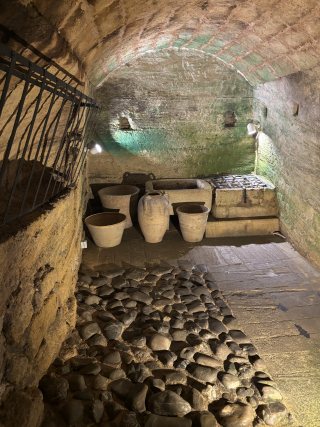
Underground olive-oil mill (Frantoio Ipogeo)
Mill carved into the rock under the old town, where lamp oil was made that Gallipoli shipped across Europe.

Church of Santa Maria della Purità
Confraternity church on the walls whose plain front hides an interior covered in paintings and a majolica tiled floor.

Purità beach
Small sandy beach right below the walls of the old town, beside the Purità church, for a swim in the warm afternoon.

Historic centre of Gallipoli (walk on the sea walls)
A walk around the old town on its island, along the sea walls past churches, fishermen's houses and views of the Ionian Sea.
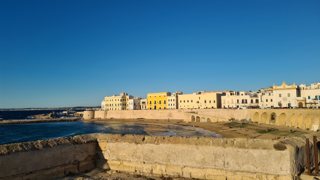
Riviera Nazario Sauro
Seafront promenade along the old town walls, with restaurants and bars; a good place for an evening aperitivo by the sea.
When to go to Puglia
May, June and September are the best months: warm, sunny and calmer than high summer. July and August are hot and busy on the coast. Winter is mild and quiet, but some seaside places close.
Plan the rest of your trip
- Where to stay: hotels in Puglia on Booking.com or Trip.com
- Skip-the-line tickets: museums and sights in Puglia on Tiqets
- Tours and day trips: things to do in Puglia on GetYourGuide or on Viator
- Data on arrival: an eSIM for Italy from Airalo
Some of these are affiliate links: we may earn a small commission at no extra cost to you.
Tips for Puglia
- Historic centres are limited traffic zones (ZTL): park outside and walk in.
- Many shops and some sights close in the early afternoon and reopen in the late afternoon.
- Beaches fill up in August; June and September are calmer and still warm for swimming.
- Many restaurants add a cover charge (coperto) per person; tipping is not expected.
- Every place here has its own ready-made guide with more days, if you want to stay longer in one place.
Make it your own
Open the guide in Andiamo Places to see every stop on a map with walking directions, move places between days, check opening hours for your dates, and add your own finds. After the trip, your photos become a journal and, if you like, a printed photo book.



Guides are made with the help of AI and public sources such as Wikipedia, and may contain errors. Opening hours and prices change, so check before you go. Spotted a wrong photo, a pin in the wrong place, a missing stop or a better one? Write to hello@andiamoplaces.com: the e-mail opens with this guide filled in.
Photo credits
- Angevin-Aragonese Castle: Stefano Natili, CC BY-SA 3.0
- Aragonese Castle of Otranto: Enric, CC BY-SA 4.0
- Baia dei Turchi: Paride81, CC BY 3.0
- Bari Cathedral: Bernard Gagnon, CC0
- Basilica of Saint Nicholas: Holger Uwe Schmitt, CC BY-SA 4.0
- Basilica of Saints Cosmas and Damian: Alisa58, CC BY-SA 4.0
- Basilica of San Martino, Martina Franca: Alisa58, CC BY-SA 4.0
- Belvedere Murgia Timone: Mattis, CC BY-SA 3.0
- Belvedere Santa Lucia: ParisTaras, CC BY-SA 4.0
- Bishop's Palace and Arco Scoppa: Carlo Pelagalli, CC BY-SA 3.0
- Boat trip to the Gargano sea caves (from Vieste harbour): Carmen Fiano, Public domain
- Cala Paura: Luca Margheriti, CC BY-SA 3.0
- Cala Porta Vecchia: Giorgio Galeotti, CC BY-SA 4.0
- Casa Grotta di Vico Solitario: Davide Mauro, CC BY-SA 4.0
- Castel del Monte: ParisTaras, CC BY-SA 4.0
- Castello Normanno-Svevo: Berthold Werner, CC BY-SA 3.0
- Castle of Charles V (Monopoli): Jules Verne Times Two, CC BY-SA 4.0
- Castle of Monte Sant'Angelo: Bernard Gagnon, CC0
- Cava di Bauxite lake: Luca Margheriti, CC BY-SA 3.0
- Church of San Matteo: Angel de los Rios, CC BY-SA 2.0
- Church of Sant'Antonio (trullo church): Alisa58, CC BY-SA 4.0
- Church of Santa Chiara: Bernard Gagnon, CC0
- Church of Santa Maria Amalfitana: Alisa58, CC BY-SA 4.0
- Church of Santa Maria della Purità: Patrick Nouhailler's…, CC BY-SA 3.0
- Foresta Umbra: No machine-readable author provided. Idéfix~commonswiki assumed (based on copyright claims)., CC BY-SA 3.0
- Gallipoli Cathedral (Sant'Agata): User:MatthiasKabel, CC BY 2.5
- Greek Fountain (Fontana Greca): Bernard Gagnon, CC0
- Grotta della Poesia: Psymark, CC BY-SA 4.0
- Historic centre of Alberobello (Rione Monti trulli): ParisTaras, CC BY-SA 4.0
- Historic centre of Cisternino: Benjamin Smith, CC BY-SA 4.0
- Historic centre of Gallipoli (walk on the sea walls): Colar, CC BY-SA 3.0
- Historic centre of Locorotondo: Livioandronico2013, CC BY-SA 4.0
- Historic centre of Martina Franca (Piazza Maria Immacolata): Berthold Werner, CC BY-SA 3.0
- Historic centre of Ostuni: ParisTaras, CC BY 4.0
- Historic centre of Otranto: Benjamin Smith, CC BY-SA 4.0
- Historic centre of Peschici (Piazza del Popolo): Creator-bz, CC BY-SA 1.0
- Historic centre of Polignano a Mare: Luca Margheriti, CC BY-SA 3.0
- Historic centre of Trani (the harbour): Sergio Santamaria, CC BY-SA 4.0
- Lama Monachile: Calogero77, CC BY-SA 4.0
- Lecce Cathedral and Piazza del Duomo: Benjamin Smith, CC BY-SA 4.0
- Locorotondo belvedere over the trulli (Via Nardelli): Carlo Pelagalli, CC BY-SA 3.0
- Lungomare Nazario Sauro: Xhensi, CC BY-SA 4.0
- Matera Cathedral: Benjamin Smith, CC BY-SA 4.0
- Monopoli Cathedral (Maria Santissima della Madia): Hagai Agmon-Snir حچاي اچمون-سنير חגי אגמון-שניר, CC BY-SA 4.0
- Mother Church of San Giorgio, Locorotondo: Carlo Pelagalli, CC BY-SA 3.0
- Muraglia and Fortino di Sant'Antonio: Enric, CC BY-SA 4.0
- Museo Faggiano: Tommasopaiano, CC BY-SA 4.0
- Museo Sigismondo Castromediano: Davide Mauro, CC BY-SA 4.0
- Old town and old port of Monopoli: The original uploader was Monopoli91 at Italian Wikipedia., CC BY 3.0
- Ostuni Cathedral: Sailko, CC BY 3.0
- Otranto Cathedral: Holger Uwe Schmitt, CC BY-SA 4.0
- Palazzo Ducale, Martina Franca: Carlo Carbotti, CC BY-SA 4.0
- Palazzo dei Celestini: Istvánka, CC BY-SA 3.0
- Piazza Mercantile: Enrique Íñiguez Rodríguez (Qoan) Credit information This work was created by Enrique Íñiguez (Qoan). You are free to use it for any purpose as long as you credit me properly (e.g. © Enrique Íñiguez (CC-BY-SA); other variants are acceptable, let me know if in doubt). .mw-parser-output .div-col{margin-top:.3em;column-width:30em}.mw-parser-output .div-col-small{font-size:90%}.mw-parser-output .div-col-rules{column-rule:thin solid var(--border-color-base)}.mw-parser-output .div-col dl,.mw-parser-output .div-col ol,.mw-parser-output .div-col ul{margin-top:0}.mw-parser-output .div-col li,.mw-parser-output .div-col dd{page-break-inside:avoid;break-inside:avoid-column} Reuse: If you use this image outside of Wikimedia projects, I would be happy to hear from you. If you use this image in a printed publication, I would love to get a copy for my archives. Contact me: If you're unsure about how you can use this picture. If you have any questions about attribution or other topics related to my files., CC BY-SA 4.0
- Piazza Sant'Oronzo: Sailko, CC BY-SA 4.0
- Piazza del Ferrarese: Michael Paraskevas, CC BY-SA 3.0
- Pizzomunno: No machine-readable author provided. Idéfix~commonswiki assumed (based on copyright claims)., CC BY-SA 3.0
- Ponte Borbonico viewpoint: Lucamato, CC BY-SA 4.0
- Porta San Biagio: Fabrizio Garrisi, CC BY-SA 4.0
- Punta Palascìa lighthouse (Capo d'Otranto): Original uploader was user:Dinobortone at it.wikipedia, CC BY-SA 3.0
- Purità beach: Falk2, CC BY-SA 4.0
- Roca Vecchia archaeological area: Psymark, CC BY-SA 4.0
- Roman amphitheatre of Lecce: Bernard Gagnon, CC0
- Roman theatre of Lecce: Bernard Gagnon, CC0
- San Pietro Barisano: Sailko, CC BY 3.0
- San Pietro Caveoso: Luca Aless, CC BY-SA 4.0
- Sanctuary of Monte Sant'Angelo: Baggio1979, CC BY-SA 4.0
- Sanctuary of Saint Pio of Pietrelcina, San Giovanni Rotondo: Nikzia, Public domain
- Santa Maria de Idris: Ilaria Giuliodori, CC BY-SA 4.0
- Sasso Barisano: Bönisch, CC BY-SA 2.0 de
- Sasso Caveoso: Bönisch, CC BY-SA 2.0 de
- Scolanova Synagogue: Aerostrato sig. Giuseppe CALAMITA, CC BY 3.0
- Sea walls and Bastione Santa Maria: Мирослав Василев, CC BY-SA 4.0
- Statue of Domenico Modugno: Unknown authorUnknown author, Public domain
- Strada Arco Basso: Chabe01, CC BY-SA 4.0
- Swabian Castle of Trani: Titti Pagnelli, CC BY-SA 4.0
- Teatro Petruzzelli: Benjamin Smith, CC BY-SA 4.0
- Torre Sant'Andrea sea stacks: Emanuele Petrachi, CC BY 3.0
- Trabucco di Punta San Francesco: Jules Verne Times Two, CC BY-SA 4.0
- Trani Cathedral: Holger Uwe Schmitt, CC BY-SA 4.0
- Trullo Sovrano: Istvánka, CC BY-SA 3.0
- Via Sparano (Murat quarter): Daniele Napolitano, CC BY-SA 4.0
- Vieste old town and Co-cathedral: Bernard Gagnon, CC0
Opening hours change; check before you go. Map data © OpenStreetMap contributors.